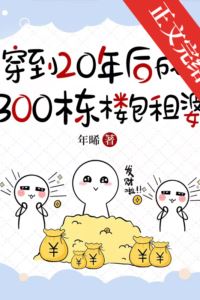
Transmigrated 20 Years Later as a Landlady of 300 Buildings
+Add to Custom List
Genres:
Novel Info
  • Author:
  • 年晞
  • Status:Ongoing

Summary

... Read More

Xia Zhi’s greatest dream in life is to become a carefree landlady who never has to worry about money, someone who checks the utility meters and collects rent each month, then spends the rest of her time enjoying life with both wealth and leisure.


Until one day, she accidentally travels twenty years into the future.


She has not only achieved her dream, she has exceeded it.


She has become a true landlady, and not just any landlady, but one who owns 300 buildings.


Faced with such a wonderful life, she would gladly say yes a hundred times over.


However…


What is going on with these four extra children? And why did their father come along as part of the package too?


Tags: Wealthy families, time travel, sweet romance, feel-good story

Search keywords: Protagonists: Xia Zhi, Wen Shihan | Supporting characters: Wen Yu, Wen Lun, Wen Le, Wen Yi | Others:

Novel Items

More
Item
A luxury watch worn by Wen Shihan on his wrist. It sparkled brilliantly under the elevator lights. It signifies his wealth and status as the CEO of Wenyue Group.
Item
A rent bill of 2,868 yuan sent by Xia Zhi's landlord via phone message. It arrived while she was waiting for the elevator, reminding her of her financial struggles despite her hard work.
Food
Rare treats from abroad that An Ruoyan had never eaten in this era. Gu Yizhi buys two boxes for her.
Event
The elevator in Wenyue Group's main building suddenly lost control while Xia Zhi and Wen Shihan were inside. It plummeted from the twentieth floor, with floor numbers flickering wildly. The elevator scraped violently against its shaft with sparks bursting out. During the accident, Xia Zhi grabbed Wen Shihan's arm and asked if they could survive. She lost consciousness after the accident.
Event
Xia Zhi had been secretly gathering evidence of Zheng Wei's embezzlement of company marketing funds. She planned to report him to Wen Shihan in the elevator before the accident occurred. This evidence was her leverage against Zheng Wei, who had a history of forcing employees out without compensation.
Item
A palm-sized calendar hanging on the white wall with the year 1980 emblazoned on its cover in four bold characters. It had never been torn, marking the time period of the story.
Latest Release
DateGroupRelease
2026-08-11shanghai fantasy c17
2026-08-11shanghai fantasy c16
2026-08-11shanghai fantasy c15
2026-08-11shanghai fantasy c14
2026-08-11shanghai fantasy c13
2026-08-11shanghai fantasy c12
2026-08-11shanghai fantasy c11
2026-08-11shanghai fantasy c10
2026-08-11shanghai fantasy c9
2026-08-11shanghai fantasy c8
2026-08-11shanghai fantasy c7
2026-08-11shanghai fantasy c6

Community Reviews

Rating(0 / 5.0, 17votes)
5 stars
0(0%)
4 stars
0(0%)
3 stars
0(0%)
2 stars
0(0%)
1 stars
0(0%)

Popular reviews

... Read More
I need to talk about those four children because my heart is literally breaking for them. The seventeen-year-old, Wen Yu—he's already carrying the weight of the entire family on his shoulders, and he's a kid himself. When their father wakes up and asks 'who are you?' and Wen Yu still refuses to give up, asking again with that desperate hope in his voice? I nearly cried. The way the author writes those moments of quiet devastation is so understated it cuts deeper than any dramatic monologue ever could. And then there's the twins, seven years old, who can't hold it together anymore and just throw themselves into their brothers' arms and sob. Who does that to children? Their parents are alive right there in the next bed, but they've forgotten them. It's such a specific, agonizing kind of pain. The most devastating line for me though is when Wen Yu asks, 'Mom, do you remember Dad?' and Xia Zhi says yes, and then he turns to Wen Shihan and asks the same thing, and Wen Shihan also says yes. They at least remember each other. But the children? Forgotten. Completely erased. That contrast between the couple's connection and the parental bond being severed is just so cruel and so beautiful at the same time. I also love how the author shows the kids' love through small gestures—Wen Lun noticing their mom's lips are dry and pouring water at the perfect temperature, Wen Yu turning on the TV to ease the awkward silence. These kids are so mature beyond their years, and it's heartbreaking. I just want to go into the page and hug them all.
... Read More
The stakes in this passage are incredibly high, and I love how the author builds tension through both external and internal conflict. On the external side, you have two people who are completely disoriented in an unfamiliar future, surrounded by strangers who claim to be their children. That's a lot to process. But the internal conflict is where it really gets intense. Xia Zhi's fear of Wen Shihan is such a great detail. She's always been intimidated by authority figures—her parents, her teachers, her boss—and now she's supposed to be married to that same boss? The irony is almost too much. She literally says, 'It felt as terrifying as someone telling her the world would end tomorrow.' That's not an exaggeration for her. This is her deepest fear made real. And then there's Wen Shihan. He's this composed, controlled man who seems capable of handling anything, but even he is visibly shaken. The author describes him with 'faint streaks of gray' in his hair, a small detail that speaks volumes about the twenty years he's lost. He's not just dealing with memory loss—he's dealing with the loss of his entire life, his children, his wife, and he has no framework to process any of it. The suspense is maintained masterfully too. Every chapter ends on a note that makes you want to keep reading. The calendar reveal, the TV news confirmation, the request for the marriage certificate and family photo album—each one raises the stakes higher. What's in that photo album? Will they find proof of their life together? And what happens when they do? I am genuinely invested in figuring out what comes next.
... Read More
Okay, so let me just say this: the elevator accident is such a brilliant inciting incident. It's not some dramatic car crash or a bomb going off. It's an elevator—something so mundane, so everyday—that it makes the whole time-travel premise feel grounded even though it's wildly absurd. And then she wakes up in 2042 with no memory of the last twenty years? Chef's kiss. The author didn't even need a fancy portal or a magical artifact. Just a malfunctioning elevator and boom, twenty years gone. But what really got me is how the plot reveals information in layers. First, Xia Zhi thinks she's just in a hospital after a car accident. Then the kids call her Mom. Then Wen Shihan wakes up and doesn't recognize anyone. Then the calendar says 2042. Each reveal hits harder than the last, and by the time the TV news confirms the date, I was sitting there like—what just happened to my life? The pacing here is impeccable. No info-dumping, just gradual, devastating reveals that compound on each other. And the twist about their memories stopping at different ages? Xia Zhi's mind is stuck at 25, while Wen Shihan apparently has a different level of memory loss. That's a plot detail I didn't see coming, and it sets up so many interesting dynamics for what comes next. How will they navigate a marriage and four kids when one of them is essentially a 25-year-old woman in a 45-year-old body? The narrative tension here is off the charts.
... Read More
There's something deeply moving underneath all the wealth display here, and I think the central symbol is those three hundred property ownership certificates. On the surface it's a flex, right? But read it alongside Xia Zhi's memories of her twenty-something self in S City—working overtime, running a night stall, eyes aching from bad lighting in her tiny room, terrified of losing her deposit, watching young people leave with their suitcases and shattered dreams—and suddenly those red booklets mean something completely different. They represent a woman who suffered as a renter and decided she would never be that kind of landlord. Wen Yu explains this directly: she never raised rent, always returned full deposits, bought entire buildings because collecting unit by unit was too troublesome. The symbolism is almost too on-the-nose but it works because the emotional core is genuine. The family portrait where she's distorting her husband's face on her shoulders—that's a symbol of power reversal too. In her past life she was nobody. In this life she's the one who forces the family photo to happen the way she wants it. Even the keys room is symbolic. A vault of ownership. Every key is a promise kept to someone who was once like her—a tenant who needed a deposit back, a roof over their head, someone who wouldn't cut off their utilities for being two days late. The city itself is a symbol. S City, where countless wealth legends are born but also where countless dreams die. Xia Zhi is the legend who made it, and the story keeps reminding us of the cost.
... Read More
Let me just start by saying the dialogue in this passage is absolutely stellar. Every character has a distinct voice, and I could tell who was speaking without even looking at the names. Wen Yu sounds like a responsible eldest son—calm, measured, always trying to hold things together. Wen Lun is quick-witted and observant, the kind of kid who notices details and acts on them. The twins? They're just kids, and the author doesn't shy away from that. One line that made me laugh out loud was when Xia Zhi says 'I'm only twenty-five this year, still in the prime of youth. Don't make me older than I am.' That is such a genuine, relatable reaction. Who wouldn't say that? It's funny and sad at the same time, and it reveals so much about her character in one sentence. The narrative voice itself is also really well-done. It stays close to Xia Zhi's perspective, so we experience the confusion and shock alongside her. The author uses short, punchy sentences during moments of high tension—'Silence. A long silence. A deathly silence.'—which creates this rhythm that mirrors her racing thoughts. And then there are these quieter, more reflective moments where the prose slows down, like when she's thinking about her youth and how she used to fantasize about romance before reality crushed those dreams. The contrast between the formal, almost clinical dialogue with the doctors and the raw, emotional exchanges with the kids is also really effective. It shows how the situation affects different characters in different ways.
... Read More
There's a moment in this chapter that I can't stop thinking about. After Xia Zhi finally takes in all four children, she comes to what she herself calls a "tragic realization": all four of them look exactly like Wen Shihan. Not a single one resembles her. As she puts it, "It was as if she had merely delivered them, and once the delivery was done, she was no longer needed." On the surface, this is just a funny, self-deprecating thought. But underneath? It's the entire thematic question of this story. Who does Xia Zhi belong to in this future? She's the mother, the wife, the center of this family photograph—but genetically, visibly, she's erased. She's the vessel, not the source. And yet the children's love for her is undeniable. Wen Yi clings to her neck. Wen Le demands hugs. They don't care that she doesn't look like them. The marriage certificate date—September 9, only three months after the elevator accident—carries similar weight. Nine plus nine. A date that looks like a promise but feels like a collision. The accident that brought them together also nearly killed them. Love and danger as twin forces. And then there's Wen Shihan's smile. Xia Zhi notes that she had never seen him smile before, that he was always serious and intimidating. But in the photo, in that white shirt, he looks "quite handsome." The smile that exists only in a future she hasn't lived yet. The theme here is clear: identity is not fixed. The man she feared becomes the man who gently strokes his son's hair. The woman who feels like an impostor becomes the mother four children beg for pinky promises. The question the story keeps asking is: when everything changes, what remains? And the answer, quietly, is love—messy, inconvenient, hot-spring-planning love.
See all reviews

Characters

See all characters

Custom lists

Oops…There is nothing here.