Summary

... Read More

Lin Suisui was ignored, hidden, and treated as if she did not exist in the Yong Duke’s Mansion. Denied her rightful place in the family and left to survive on her own, she was the forgotten fourth daughter no one cared about.

Then everything changed.

After dying once, Lin Suisui awakens with memories of the future. She knows that within days, her entire family—the powerful Yong Duke’s Mansion—will be destroyed. Framed for treason, accused of colluding with an enemy nation, and betrayed by someone they trusted most, every member of the family is destined for execution.

This time, she refuses to let history repeat itself.

Working from the shadows, Lin Suisui secretly warns her grandmother, saves the Empress Dowager from assassination, uncovers the hidden enemy princess planted inside the mansion, and begins dismantling the deadly conspiracy piece by piece.

But the greatest danger does not come from outside.

It comes from the family’s beloved eldest daughter, Lin Xiner—who willingly sacrifices the family that raised her to secure power, status, and a brighter future for her own husband and son.

As the Emperor quietly moves his pieces across the board, accusing loyal ministers of treason and preparing to erase the Yong Duke’s Mansion forever, Lin Suisui must stay one step ahead. Every choice she makes could save hundreds of lives—or doom them all.

Can one forgotten daughter rewrite fate before the executioner’s blade falls?

In a battle of loyalty, betrayal, and political intrigue, only the one who knows the future has a chance to change it.

Novel Items

More
Document
A letter allegedly written by Hu Meng, Grand Marshal of the Jin Kingdom, addressed to Lin Zhengbei as his sworn brother. The letter claims the two secretly planned to overthrow the Great Yong Dynasty. According to Lin Suisui's warning, Lin Xiner would secretly place this letter inside Lin Zhengbei's study on the third day of the Lunar New Year as a frame-up plot.
Item
Books used for learning calligraphy, stored in Lin Zhengbei's study. Lin Xiner claimed she wanted to find some copybooks for her son Yu Ge'er's first lessons. She used this as an excuse to enter the study where she would secretly place the treason letter.
Item
Red envelopes handed out by Gu Yizhi's comrades to Deng Xiuli and Hao Panpan at the door to ease tension and allow them to pick up their bride.
Document
A two-page letter hidden inside a copy of the Analects by Lin Xiner. It contains evidence of working with the enemy, which is treason punishable by destroying the entire family. Lin Suisui threw the letter into the fire after reading it but kept the envelope.
Textbook
A classical text containing chapters such as Gongye Chang, Yong Ye, and Wei Ling Gong. Jin had memorized multiple volumes of this text ahead of his brother.
Currency
500,000 paper banknotes brought by Tu Feng to circulate among the tribes. 390,000 were recovered, leaving 110,000 uncollected. Lu Qizhou's plan is to establish paper money as the economic lifeline of the Beast Continent.
Latest Release
DateGroupRelease
2026-08-11shanghai fantasy c26
2026-08-11shanghai fantasy c25
2026-08-11shanghai fantasy c24
2026-08-11shanghai fantasy c23
2026-08-11shanghai fantasy c22
2026-08-11shanghai fantasy c21
2026-08-11shanghai fantasy c20
2026-08-11shanghai fantasy c19
2026-08-11shanghai fantasy c18
2026-08-11shanghai fantasy c17
2026-08-11shanghai fantasy c16
2026-08-11shanghai fantasy c15

Community Reviews

Rating(0 / 5.0, 9votes)
5 stars
0(0%)
4 stars
0(0%)
3 stars
0(0%)
2 stars
0(0%)
1 stars
0(0%)

Popular reviews

... Read More
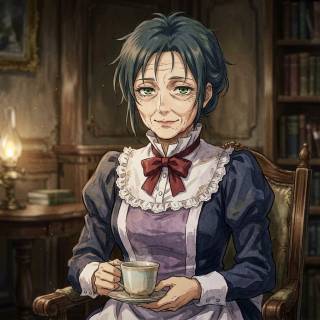
Okay so this scene where Lin Suisui tells Nanny Yan to stay back and not disturb the Empress Dowager and Old Madam? I need to talk about this moment because it's actually kind of brilliant in how it reveals Nanny Yan's character arc. Nanny Yan is introduced as this stern, intimidating figure who's served the Empress Dowager for decades. She's thin, she doesn't smile much, and Lin Suisui literally compares her to palace servants who've absorbed the coldness of power. But then the Old Madam calls her by her childhood name — Nanny Tao — and suddenly this woman who's been hardened by palace life gets emotional. Her eyes turn red. She forgets her own name almost, but the Old Madam remembers. And then Lin Suisui drops this authoritative line on Nanny Yan, and instead of getting offended, Nanny Yan actually reads the girl. The text says: "She unconsciously put away the contempt in her eyes and began to take the young girl seriously." That's a whole character shift right there. This woman who's seen everything in the palace, who's served an Empress Dowager for decades, looks at this skinny little maid and suddenly sees a high-ranking imperial consort. That's not just plot convenience — that's the author showing us that Lin Suisui carries herself with this invisible authority that transcends her status. But here's what really gets me: Nanny Yan doesn't argue. She doesn't push back. She just... stops. She understands the unspoken message immediately. That tells me everything about her loyalty and her intelligence. She's not just a servant — she's a survivor who knows how to read rooms. And the Empress Dowager's internal monologue about Nanny Yan afterward? "Trusting someone in her heart was one thing. But she did not want to reveal Lin Suisui—her hidden trump card—in front of anyone." This is the kind of political calculation that makes me respect this author's understanding of power dynamics. Everyone is playing chess here, and Nanny Yan is one of the pieces who actually knows she's being moved.
... Read More
I have to talk about this one scene because it's genuinely cinematic and I think the author is doing something really clever with the setting. The Cuiping Nunnery is described as having "many courtyards of different sizes" and "many scenic spots throughout the grounds." It's winter, flowers and plants have withered, but there's still "quiet natural beauty" in the rocks and green bamboo. This is already establishing a mood — cold, restrained, but not dead. There's life underneath. Then you have the Mirror Stone. An enormous, almost perfectly round stone standing upright like a giant bronze mirror. And when the Empress Dowager and Old Madam step behind it, they completely disappear from view. Lin Suisui and Nanny Yan are left standing far away, and the text specifically says they look less like people waiting and more like "they were keeping watch, making sure no one approached." This is such a good use of physical space to create narrative tension. The stone acts as a literal and metaphorical barrier — behind it, two powerful women have a private conversation about poison and political assassination. In front of it, a skinny little maid and an old nanny stand guard, and the maid gives an order that the nanny obeys without question. The entire power structure of this scene is communicated through who can see whom and who is hidden from whom. The nunnery itself is interesting too. It's where the Empress Dowager has withdrawn to avoid conflict with the Emperor and Consort Dowager Shen. She came here because she was "tired of constantly clashing." But the Old Madam dreams about this place — "Every time I close my eyes, I dream of Cuiping Nunnery." The Bodhisattva apparently guided her here. Whether that's divine intervention or just narrative coincidence, the author is using this religious setting to frame the entire political struggle as something with cosmic stakes. I keep coming back to that image of two elderly women disappearing behind a giant round stone while a child and an old servant stand guard. It's got to be one of the most visually striking scenes in this batch.
... Read More
Okay so the pacing in this batch is doing something really interesting and I want to unpack it. We start with the reunion at Cuiping Nunnery — warm, almost peaceful, with the two elderly women sharing a meal and chatting about childhood. It feels like a breathing room scene. But then Lin Suisui observes the servants and internally calculates who could have poisoned the Empress Dowager. The tension starts creeping in. Then the walk to the Mirror Stone, the private conversation behind it, the revelation that the Emperor plans to move on the ninth day. The peace is completely shattered by chapter's end. And then Chapter 15 opens with Lin Xiner returning to the Duke's Mansion. The text tells us: "Lin Xiner truly lived up to the Old Madam's expectations. On the eighth day of the first lunar month, she returned to the Duke's Mansion again. Moreover, she had not sent anyone ahead the day before to announce her visit." This is such a deliberate pacing choice. The Emperor's move is on the ninth day. Lin Xiner returns on the eighth. Everything is counting down. The author is using the calendar itself as a ticking clock. What's clever is that Lin Xiner's return seems almost casual on the surface — she's visiting her grandmother during the New Year, how hard can it be? — but the narrative has already loaded this moment with enormous significance. We know the Duke's Mansion is in danger. We know the Empress Dowager is being poisoned. We know the Grand Court Assembly is one day away. And now this married daughter who usually lives at her husband's home shows up unannounced, skipping proper etiquette, going directly to the Old Madam instead of her mother. The chapter ends with Lin Xiner crouching beside the Old Madam, and the text cuts off right as the Old Madam is pleased by her affection. But the reader is already thinking: what does she know? What is she planning? The pacing here is masterful because it makes you feel like everything is moving faster even though the scenes themselves are quiet and domestic.
... Read More
Let me just say this upfront: the stakes in this section are absolutely razor-sharp and I cannot stop thinking about the poisoning plotline. The Empress Dowager is being poisoned. Not by some faceless enemy — by someone in her inner circle. The Old Madam lays out the logic perfectly: the Emperor will make his move during the Grand Court Assembly on the ninth day of the first lunar month. Before that, he needs to eliminate her. Why? Because if the Duke's Mansion gets confiscated and the family exiled, the Old Madam will never stand by. And the Emperor's birth mother, Consort Dowager Shen, also wants her dead. So the Empress Dowager is trapped between two threats — the Emperor's political maneuvering and his mother's personal vendetta — and the poison is coming from someone who serves her directly. The three suspects are Nanny Yan and two other nannies. Ordinary people can't get close to her. The nunnery's food and tea are safe. It has to be someone who serves her personally. And here's where it gets really tense: the Old Madam warns her that even Nanny Yan could be a suspect. But the Empress Dowager says with complete confidence: "Anyone may betray me, but Nanny Tao never would." She calls her by her childhood name. She trusts her. But the reader — we know from the previous life that the Empress Dowager trusted the wrong person before. She raised a tiger that turned against her. So every declaration of loyalty in this scene is tinged with dramatic irony. The stakes are crystal clear: if the Empress Dowager dies, the Duke's Mansion loses its most powerful protector. If the Duke's Mansion falls, Lin Suisui's family is exiled. And Lin Suisui knows exactly how this ends because she lived it before. That's the kind of suspense that makes you want to keep reading — not just wondering what happens, but knowing what happens and desperate to see if it can be changed.
... Read More
I need to talk about the lunch scene because the dialogue here is deceptively simple and I think that's what makes it work so well. The Empress Dowager, the Old Madam, and Nanny Yan sit down to eat. The Old Madam insists that Nanny Yan join them, calling her by her childhood name Nanny Tao. The Empress Dowager says: "Today there is no Empress Dowager and no servant. There are only three childhood friends. Sit down and eat with us." And Nanny Yan's response? "Your Majesty, that wouldn't be proper. I'll remain standing and serve you." She sits only on the edge of the chair — "that was palace etiquette. Even when a master allowed a servant to sit, the servant could only sit on half the seat." This dialogue does so much work. On the surface, it's a warm reunion between old friends. But underneath, you can feel the weight of decades of palace hierarchy pressing down on Nanny Yan. She can't unlearn her conditioning. Even when told she's equal, her body remembers her place. The Old Madam has to physically push her into the chair. And then there's Lin Suisui's line to Nanny Yan: "Nanny, our Old Madam wants to have a private conversation with the Empress Dowager. We shouldn't disturb them." The text notes: "When she spoke, she did not sound like she was making a suggestion. She sounded as if she were giving an order." This is such a clean example of voice. Lin Suisui doesn't raise her volume. She doesn't add emphasis. She just speaks with this calm certainty that makes everyone around her adjust. And Nanny Yan, who has served an Empress Dowager for decades, recognizes it immediately. The dialogue throughout this section is remarkably efficient. There's very little wasted words. Every line either reveals character, advances the plot, or both. The author isn't showing off with elaborate speeches — they're letting the subtext do the heavy lifting.
... Read More
I need to just sit with this for a moment because the Lin Zhengbei reveal absolutely destroyed me. So his daughter — the one he apparently barely acknowledged — was living in this mansion under the name Huan'er, receiving only ONE Tael of silver per month when even illegitimate daughters get ten. No charcoal. Cold dumplings. Greasy soup. And she never knew her own name was in the family records. She wasn't even on the household register. And then Lin Zhengbei just... drops it like it's nothing. "I gave her that name myself. I hoped she would live a happy and carefree life." In his head, maybe. But his actions told a completely different story. He named her but erased her. This man is a military commander who commands two hundred thousand soldiers, yet he couldn't or wouldn't protect his own daughter from being starved and frozen in his own mansion. Meanwhile, Wang Qingwan — the main wife — is the one actively mistreating her. The Old Madam's reaction was everything. Her voice choking, saying "how could Wang Qingwan treat you like this" — she's seeing her grandson's neglect for the first time too. But here's what's fascinating: Lin Zhengbei's relationship with Lin Suisui is shifting RIGHT NOW in these chapters. When he asks "What should we do now?" it's clear he no longer sees her as just a young girl. The power dynamic has flipped. She's the one with foresight, with plans, with the knowledge of the future. He's listening. He's following her lead. And the Old Madam? She's the emotional anchor of this whole family. Trembling when she hears about the prison deaths, but still firm. Still trusting her granddaughter. "You were given this second life to save the Duke's Mansion." That line hit me so hard because it's not blind faith — it's a grandmother choosing to believe in her granddaughter despite everything. The family dynamics are so rich. Lin Zhengnan going from terrified to action-oriented in seconds. Lin Zhengchen staying sharp and practical. Each brother has a role, and Lin Suisui is orchestrating them like a conductor.
See all reviews

Characters

See all characters

Custom lists

Oops…There is nothing here.