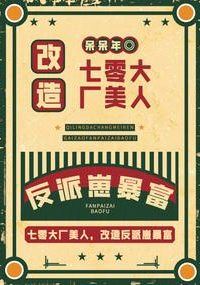
The Beauty from the 1970s State-Owned Factory Reforms the Villainous Cub and Strikes It Rich
+Add to Custom List
Genres:
Novel Info

Summary

... Read More

Chen Qing transmigrated into a period novel, becoming the aunt of a beautiful, powerful, and tragic antagonist.

The “beautiful and powerful” traits were innate to the antagonist, while the “tragic” part was inflicted by her.

The original host starved him, left him cold and neglected, subjected him to constant abuse, and eventually drove him out of their home, causing the death of his biological sister. As the antagonist grew more twisted, he eventually became a cold-blooded, ruthless capitalist who exacted brutal revenge on the original host, landing her directly in prison.

Upon transmigrating, Chen Qing initially thought that arriving early might give her a chance to survive.

But after calculating the family’s finances—negative!

Chen Qing’s vision went dark.

It was over—a hellish start.


Forced to work a day job while secretly hustling on the side, Chen Qing even brought her villainous nephew along, tapping into the future capitalist tycoon’s ideas.

Just as her career was advancing and her side hustle was booming, an extra person showed up at home.

Huh? Why was that aloof flower from the factory moving into her house?

He Yuan: “The man on your marriage certificate, the uncle of your two little ones—I have every right to live here.”

Novel Items

More
Materials
A meat coupon given by Chen Qing to He Yuxiang to buy stir-fried pork at the state-run restaurant. In the 1970s, meat coupons were required to purchase meat products.
Item
Brought by Yang Xichen to the hospital ward containing meat porridge for Haitang. He handed her the box and spoon to eat.
Item
Pork dish bought from the state-run restaurant by He Yuxiang. It had a savory soy sauce flavor with chili peppers and garlic. Chen Qing enjoyed it greatly as someone who had eaten poorly in her previous life.
Item
Medicine that Cheng Youyou brought to treat Mu Yu's wounds. She intended to apply it to the bite marks and burns covering his body. She had not brought any herbs specifically for burns, so she relied on her healing powers instead.
Materials
An Ruoyan used all her savings to buy gold in her previous life because it is hard currency. She planned to sell it when needed, even if she did not successfully transmigrate.
Betrothal Gift
Offered by the Qin family as part of the betrothal gifts for the wedding between Bei Qinghuan and Qin Zhenghua. Mei Suqin proposed this as part of the wedding arrangements.
Latest Release
DateGroupRelease
2026-08-11shanghai fantasy c58
2026-08-11shanghai fantasy c57
2026-08-11shanghai fantasy c56
2026-08-11shanghai fantasy c55
2026-08-11shanghai fantasy c54
2026-08-11shanghai fantasy c53
2026-08-11shanghai fantasy c52
2026-08-11shanghai fantasy c51
2026-08-11shanghai fantasy c50
2026-08-11shanghai fantasy c49
2026-08-11shanghai fantasy c48
2026-08-11shanghai fantasy c47

Community Reviews

Rating(0 / 5.0, 32votes)
5 stars
0(0%)
4 stars
0(0%)
3 stars
0(0%)
2 stars
0(0%)
1 stars
0(0%)

Popular reviews

... Read More
I need to talk about He Yuting for a second because this girl is carrying so much and the author gives her exactly three lines to do it and each one hits like a truck. 'Auntie almost died.' That's it. That's the whole emotional weight of a nine-year-old girl who watched the only adult she has left nearly suffocate in a cabinet, and she says it while walking home carrying a wooden bucket on her shoulder. No drama. No melodrama. Just a statement of fact that contains an ocean of fear. And then He Yuxiang's response—'She was lying'—followed immediately by his secret plan to cook hidden greens for his sister. He doesn't comfort her with words. He comforts her with food. That's the language of kids who have learned that love means keeping each other alive. The scene where He Yuting clamps her hand over her mouth to stifle her sobs because she's terrified her aunt will disappear if she makes too much noise? I actually felt physical pain reading that. This is a child who has been punished for expressing emotion and now she's modulating her grief to fit inside someone else's capacity to handle it. And Chen Qing, who is basically a stranger to them, feels guilt just watching this. She draws the girl into her arms and pats her back. It's the first genuine moment of warmth between them and it's earned because Chen Qing recognizes herself in He Yuting's performance of compliance. The emotional core of this whole story isn't romance or revenge. It's two people who've learned to survive alone discovering that survival is easier when you're not alone.
... Read More
Okay, I need to talk about Director Lin because this woman is genuinely fascinating. One second she's absolutely demolishing a family over the educated youth policy—voice like thunder, not taking any nonsense—and the very next moment she's switching to this warm, patient tone with Chen Qing, like a semiconductor radio going from static to soft music. That contrast is not accidental. The author is showing us someone who is fully capable of being ruthless when it matters, but also genuinely cares about the people she's responsible for. She brought White Rabbit candy for both kids, she pushed for them to go to school, she even negotiated a compromise for that family so the son could be placed closer. She's not just some bureaucratic figurehead. She's the kind of person who holds real power and actually uses it. And Chen Qing's relationship with her is so interesting too. The original host clearly had a complicated dynamic with Director Lin—there was tension there. But now Chen Qing is navigating it with this quiet respect, and Director Lin responds to it. She calls on Chen Qing by name, praises her side work, invites herself over. It's a mutual recognition of competence. Meanwhile, He Yuxiang's reaction to Director Lin—ears turning bright red, scrambling to put down his buckets, trying so hard to be respectful—shows how much this woman commands authority in the compound. She's basically the unofficial matriarch of the whole machinery factory community. Then there's the Tian Mengya angle. Chen Qing's assessment of He Yuan as some kind of troublemaker who seduced Chen Qing is honestly hilarious. The original host clearly had a history with this man, and Chen Qing is already forming opinions about him before we even know much about him. I'm curious where that goes.
... Read More
I need to talk about the stakes in this chapter because they're everywhere and they're all real. On the surface, Chen Qing's conflict is financial. She has debt. She has two children to provide for. Her income is barely enough. Every decision—where to buy meat, how to allocate wages, whether to let the kids go to school—is a high-stakes calculation. The author makes you feel the weight of thirty yuan monthly debt repayment against sixty-two yuan of remaining income. This isn't abstract. This is survival with a spreadsheet. But the stakes escalate rapidly. The black market scene is genuinely dangerous. Chen Qing is a young woman alone, tailing someone, in a place where identities are hidden and consequences are severe. She senses the follower, walks past the police station deliberately, blends into the crowd. She's experienced this before—harassed, followed—and her response is calm, calculated, effective. But the reader knows this could have gone wrong. Then there's the educated youth family, and the stakes are life-altering. The son must go to the countryside. The daughter must break up with her boyfriend or he goes instead. The boyfriend's bone is broken. The brother attempted suicide. Director Lin is negotiating a compromise, but the pressure is immense. If the family doesn't comply, they could lose their jobs. This is not a small conflict. This is a policy that tears families apart and the author doesn't soften it. And woven through all of this is Chen Qing's personal stake: her secret identity. She's living someone else's life, managing their debts, navigating their relationships, protecting their children. The original host died under suspicious circumstances connected to the black market. Chen Qing is walking the same paths. The danger isn't hypothetical—it's personal. What makes the stakes work is that the author never lets you forget them. Even in the tender moments—Director Lin giving candy to the kids, He Yuxiang's ears turning red, the family savoring every drop of sauce—the underlying tension remains. Nothing is safe. Everything could change.
... Read More
The pacing in this chapter is absolutely masterful. Let me break down why: it opens with a high-stakes negotiation scene—Chen Qing threatening teachers with the Revolutionary Committee—which immediately establishes her as someone who will go to extreme lengths for the children. Then we get a quieter, almost domestic moment where she decides to visit the recycling station. The pace slows down, we breathe, and then—BAM—the He Yuan encounter. The action escalates rapidly from a simple conversation to a full physical altercation to the most embarrassing moment of He Yuan's life, all within a few paragraphs. After that peak, the author does something really smart: they let the tension deflate. Chen Qing sneaks home, can't sleep, worries about retaliation. The next day is almost comically mundane—dozing off at work, complaining about lunch, getting scolded by Director Liu. It's a perfect narrative valley before the final act. And then the evening party scene hits like a freight train. Chen Qing walks into a room of thirty-seven important people and immediately turns the entire situation to her advantage by pretending she's there to pack leftovers. The pacing never drags, never rushes, and every scene transition feels earned.
... Read More
There's this one moment where Chen Qing takes a bath and looks around her new home—the three-hundred-square-meter courtyard in the provincial capital of Guangdong—and she thinks: "In the future, it would be worth at least twenty million, right?" Twenty million yuan. That number hangs in the air like a ghost. It's not real yet. She doesn't own it yet. She's still drowning in debt, still eating coarse grains, still bathing in water she heated herself in a cooking pot. But in her mind, this crumbling courtyard is already worth more than most people will earn in a lifetime. The courtyard is a symbol of everything Chen Qing is fighting for. It's not just property—it's security. It's the difference between surviving and thriving. In her previous life, she "scrimped and saved for so obsessively" that she never quite got there. Now, in this new life, the courtyard is waiting for her. It's a promise that if she just keeps working, just keeps being smart, just keeps surviving, she will eventually have what she always wanted. But here's the thing—the courtyard isn't really hers. Not yet. She has to repay 178 yuan in debt. She has to wait until "the two children came of age." It's a future promise, not a present reality. And that tension—between what is and what could be—is the engine of the whole story. The geckos and spiders on the ceiling are another symbol I can't stop thinking about. Chen Qing "didn't dare to move them" because she was scared. But she also "was just used to coexisting with these creatures." It's a perfect metaphor for her situation—she's not comfortable, she's not safe, but she's learned to live with the discomfort. She's adapted. She's surviving. The sponge cake is also symbolic, though in a different way. It represents the old world's values—devotion, romance, social obligation. Yang Xiujin offers it as a gesture of affection, but Chen Qing can't accept it because she's operating in a different value system. She's not thinking about romance; she's thinking about debt, about survival, about the future. The cake is a relic of a world she's trying to leave behind. And the factory itself—the Linhai Machinery Factory, ranked fourth nationwide, desperate to break into the top three—this is a microcosm of the whole society. Everyone is competing, everyone is trying to climb, everyone is measuring their worth in rankings and achievements. Chen Qing is just another cog in the machine, except she's the cog that's already figured out how the machine works.
... Read More
I need to process what just happened with that family. The educated youth policy is one thing when you're reading about it abstractly, but then the author drops this scene and I was genuinely shaken. The boy who hid in his room, who apologized to his sister while crying his eyes out—and then KICKED OVER A STOOL and SMASHED a glass photo frame. His sister's white shirt from last year's family photo literally cracked under the glass. And she just... glanced at it and silently wept. Not a word. Just silence. That detail about the photo frame is everything. It's not just a prop. It's a family portrait—something supposed to preserve a moment of togetherness—and it's being destroyed in real time by the policy that's tearing them apart. The brother promised her he'd stay home. He broke that promise not through action but through his inability to accept what's happening. He's a child too, for God's sake. And Chen Qing's reaction—drawing a sharp breath, asking immediately about the brother and the boyfriend—shows she's not just an observer. She feels this. The boyfriend got his bone broken trying to elope with her. That's not drama for drama's sake. That's love as desperation. What got me the most though was the contrast with Chen Qing's own family. Later, she's sitting at the dinner table with He Yuxiang and He Yuting, and they're savoring every drop of sauce on their plates. These kids have so little, but they're together. The family at the compound has everything on paper—a home, parents, siblings—and it's being ripped apart. I kept thinking about that cracked photo and how some things, once broken, can't be glued back together no matter how hard you try.
See all reviews

Characters

See all characters

Custom lists

Oops…There is nothing here.