Summary

... Read More

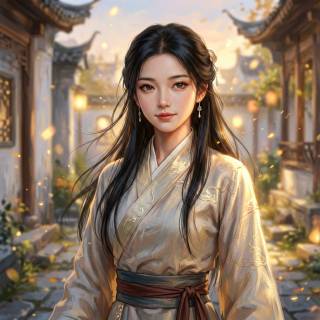
Gu Shiyi, a female college student majoring in agriculture, suddenly travels back in time and becomes the orphaned daughter of a hunter. After her hunter father dies, her stepmother forces her to marry an old wealthy man in the county as a concubine.

Taking her big yellow dog with her, she escapes to a sinkhole in the mountains where her father once hunted and lived alone there. By digging for wild vegetables, catching small game, clearing land, and farming, she relies on the agricultural knowledge from her previous life to live comfortably in the mountains, enjoying a quiet and peaceful life.

However, things don’t go as she wishes. Years of natural disasters and hardships follow one after another, and life in the mountains is no longer peaceful. One day, while searching the mountains as usual for wild vegetables and forest goods, she rescues a handsome and extraordinary man…

Main characters: Gu Shiyi, Zhou Yuezhi

Novel Items

More
Treasure
A green jade pendant tied with a red string, left by Gu Shiyi's mother. It emitted a faint glow and, when unwrapped from a cotton handkerchief, released a flash of bright green light and disappeared into Gu Shiyi's palm, granting her a spatial ability with a plot of land and a pool of crystal-clear water.
Materials
A common herb used to treat bruises, fractures, swelling, and pain. It promotes blood circulation, reduces swelling, and relieves pain. Gu Shiyi crushed it with a sickle and applied it to her sprained ankle for relief.
Item
A large, heavy basket Su Xiaoyin carried on her back after returning from the city. It was completely filled with items including a medicine-grinding pestle, medicinal herbs, and braised dishes.
Tool
A sickle that Ye Wuyou takes from the main hall and places in a basket as a cover when going into the mountains. She uses it to hack a path through the thick vegetation deep in the forest.
Medical Device
Xue Nan uses a crutch due to her bone injuries which are still recovering. She is supported by Xue Chen while using it when they encounter Xia Zhen and Pei Cheng'an at the stadium.
Food
Two wild chicken eggs boiled by Ye Wuyou for Ling Yu. He did not eat them himself but split them and gave one to Ye Wuyou and one to his brother Ling Zixiao. He even peeled one for Ye Wuyou to help her build strength.
Latest Release
DateGroupRelease
2026-08-11shanghai fantasy c58
2026-08-11shanghai fantasy c57
2026-08-11shanghai fantasy c56
2026-08-11shanghai fantasy c55
2026-08-11shanghai fantasy c54
2026-08-11shanghai fantasy c53
2026-08-11shanghai fantasy c52
2026-08-11shanghai fantasy c51
2026-08-11shanghai fantasy c50
2026-08-11shanghai fantasy c49
2026-08-11shanghai fantasy c48
2026-08-11shanghai fantasy c47

Community Reviews

Rating(0 / 5.0, 26votes)
5 stars
0(0%)
4 stars
0(0%)
3 stars
0(0%)
2 stars
0(0%)
1 stars
0(0%)

Popular reviews

... Read More
I've been thinking about this book more than I probably should, and there's something deeper going on beneath the farming and shopping surface. The space itself — it started small and keeps growing. "When crops mature, the space would expand." This isn't just a convenient plot device. It's a metaphor for self-sufficiency, for building something from nothing. Every crop she plants, every seed she saves, every expansion of that space represents her taking control of her own life. She's not dependent on anyone. The mountains, the dogs, the space — it's her entire world and she's building it brick by brick. Then there's the disguise. She dresses as a servant, puts soot on her face to hide her beauty. "From a distance, it looked like a large dark birthmark." Why does she do this? Because the world outside her mountain isn't safe for someone like her. The disguise is both protection and commentary — she has to erase herself to survive in society. But inside the space, she doesn't need to hide. She can just be Gu Shiyi. And the bamboo rats — caught by dogs, sold for silver, used to buy seeds and supplies. It's this beautiful cycle of giving and receiving. The dogs hunt, she sells, she invests back into the future. There's a theme here about interdependence and smart resource management that I think a lot of readers glide right past. The salt detail hit me too. "In the deep mountains, even without grain, she wouldn't starve... But salt was different." Salt as a symbol of civilization, of connection to the outside world, of the thin line between survival and thriving. She could survive alone in the mountains, but salt pulls her back to town, back to society, back to the cycle of trade and exchange.
... Read More
Let's talk about what's actually at stake here, because on the surface this seems like a cozy survival story but there's real tension underneath. Gu Shiyi is isolated. She's in a sinkhole with no visible exit, no other people around, and limited supplies. The stakes are basic but fundamental: eat or don't eat. Survive or don't survive. Everything she does in these chapters is driven by that underlying anxiety, even when it's dressed up as a pleasant afternoon walk. The bamboo rat conflict is the perfect example. On one level, it's funny — a girl terrified of rodents being presented with twenty of them. But on another level, it's a genuine dilemma. These are food. They're protein. They could be sold for money, which means she could buy grain and supplies and be more secure. But they're also SCARY. She has to overcome her fear to secure her future. That's not trivial. The author makes you feel her hesitation, her negotiation with the dogs, her eventual surrender. Every step is a small victory over fear. The money angle raises the stakes even more. She has over a hundred taels of silver but "she couldn't just live off her savings forever." This is the real conflict — not a villain or a war, but the slow, grinding pressure of running out. Every resource she finds, every animal she catches, every crop that grows is a buffer against that future emptiness. The tension isn't explosive; it's constant. It's the background hum of her entire existence. And the space expanding? That's hope. That's the story telling you, subtly, that things are getting better. She's not just surviving — she's building. The stakes aren't just about staying alive today; they're about creating a life she can actually thrive in. And that's what makes you keep reading. Not "will she die?" but "what will she build next?"
... Read More
The stakes in this section are incredibly high and they keep escalating. Let's start with Cui Shi. She's a young widow with a son who doesn't trust her, no land, no husband, and a village that's probably talking. Her decision to sell the farmland and marry into the Liu family isn't just a choice—it's survival. If she doesn't secure a new household, she and her son become 'black households' with no legal identity. In this era, that's basically a death sentence. But the real tension comes from Gu Shiyi. She's escaped the Gu household, but she's still out there in the mountains with wolves, cold, hungry, and carrying stolen silver. The fact that she runs all the way back to the sinkhole without stopping shows how desperate she is. And then she discovers Cui Shi's locked chest—three hundred taels of silver, property deeds, household registration. This is the kind of find that changes everything. But it also means she can never go back. Cui Shi will know. The theft is discovered. The conflict is inevitable. Gu Shiguang's storyline adds another layer of stakes. He's been secretly saving money, preparing for trouble, and when he hears Gu Shiyi was 'taken by wolves,' his relief tells us everything. He knows she escaped, and he's glad—because if she's gone, the attention shifts away from him. But he's also running out of time. His mother is remarrying, the family is dissolving, and he's alone in the academy. The suspense here is maintained perfectly because every character is making moves that will collide. Cui Shi is planning to marry into the Liu family. Gu Shiyi is hiding in the mountains with stolen wealth. Gu Shiguang is saving his silver for a future he can't control. The reader knows these paths are going to cross, and that anticipation is what keeps you turning pages.
... Read More
Let me just lay out the stakes because they are genuinely high and the author knows it. Gu Shiyi is an orphan with over a hundred copper coins, a sprained ankle, and no family. She's been sold into concubinage by her own stepmother to an old wealthy man named Master Liu. She has escaped, but she's deep in the mountains with no guarantee that Master Liu won't send people after her. The cave her father used to visit is her only shelter, and she's not even sure how much food he left behind. But here's what makes the tension work so well: the author doesn't just rely on external threats. There's this constant internal conflict running underneath everything—the question of whether she can actually survive in this world, whether her modern knowledge and transmigration advantages are enough, whether she's making the right choices. When she's limping through the forest with a crutch she made from a pine branch, every step is a reminder that she's vulnerable and alone. The injury subplot is brilliant for maintaining tension. She could have just healed instantly with the magical space, but the author deliberately delays that. She has to find bone-setting herbs, crush them with a sickle, and bandage her own ankle while exhausted and in pain. This keeps the physical stakes present and immediate throughout the entire sequence. And then there's the forest scene where Ah Hui and Ah Hua start barking urgently. For a few seconds, the reader is made to believe there's a dangerous wild animal nearby. Gu Shiyi's heart races, she thinks about her black belt in taekwondo (which, let's be honest, is not going to help against a wolf), and then it turns out to be wild chickens. But that moment of fear—brief as it is—reminds us that this world is dangerous and she's not prepared for it. The suspense is maintained because every chapter introduces a new problem to solve: treat the injury, find food, explore the space, avoid detection. There's no resting point, and that's exactly what keeps you turning pages. The author understands that tension isn't about big explosions—it's about the accumulated weight of small, urgent problems piling up on a protagonist who has nowhere to hide.
... Read More
Okay so let me just say this upfront: the transmigration setup here is about as classic as it gets, and I mean that in the best way possible. The author doesn't waste time with elaborate world-building exposition dumps. Gu Shiyi wakes up, figures out she's been reborn into a fifteen-year-old orphan's body, and immediately has to deal with the fact that her stepmother just sold her to some ancient rich man as a concubine. That's it. That's the inciting incident. No twenty-page backstory. She runs. Good. What I found really clever about the plot structure is how the author layers the stakes. First it's just survival—she's running through the mountains with a sprained ankle. Then she discovers the magical space through the jade pendant, which instantly raises the question: what else can this thing do? And then there's the background tension of her stepmother's plan closing in. The narrative keeps pulling you forward with these mini-mysteries—the stone tablet with no words, the spiritual spring water, the exact rules of the space. Every chapter ends on some kind of hook that makes you want to keep going. The pacing is also surprisingly tight for a first seven chapters. We get the transmigration, the escape, the injury, the space discovery, the wild chicken hunt, the egg nest, the mushroom gathering—all in under 20,000 characters. Nothing feels padded. The author knows exactly when to speed up and when to slow down for emotional beats. One thing I want to ask though: that jade pendant. It glowed, it disappeared into her palm, and now she's got this space. But what's the catch? Every novel with a magical space has some kind of limitation or hidden cost. I'm genuinely curious how the author plans to balance the power fantasy with actual tension. If Gu Shiyi can just store everything and heal instantly, where's the drama going to come from?
... Read More
I need to talk about the emotional complexity here because this chapter is layered. On one hand, you have Gu Shiyi who's just trying to survive in this harsh world. She's exhausted after running all day, and she finds peace in her space—organizing her things, planning to raise chickens for eggs. It's a quiet, almost domestic moment that makes you root for her. But then you have Cui Shi, and the emotions here are all twisted. She's performing grief for the village, but internally she's cursing her stepdaughter. The text shows her crying to Liu Yuanwai, pressing her body against him, using tears as a weapon. It's manipulative, sure, but there's also something pathetic about her. She's alone, she's worried about money, she's trying to survive in a world where women have little power. The most emotional moment for me was when Cui Shi thinks about her deceased husband. She remembers how well he performed in bed and feels her body heat up. This is such a raw, honest moment—she's not just a scheming villain, she's a woman with desires and needs. The author doesn't shy away from showing her humanity, even while she's doing terrible things. And Gu Shiyi's relationship with her father is hinted at—how he used to make her smear soot on her face and wear plain clothes so no one would covet her beauty. This shows a father who was protective, maybe even fearful of what could happen to his beautiful daughter. It adds depth to why Gu Shiyi might be running or hiding. The emotional tension between Cui Shi and Liu Yuanwai is also intense. She's using him, and he's... well, the text leaves it ambiguous whether he's using her back. There's this power play happening, and it's making me wonder what will happen next.
See all reviews

Characters

See all characters

Custom lists

Oops…There is nothing here.